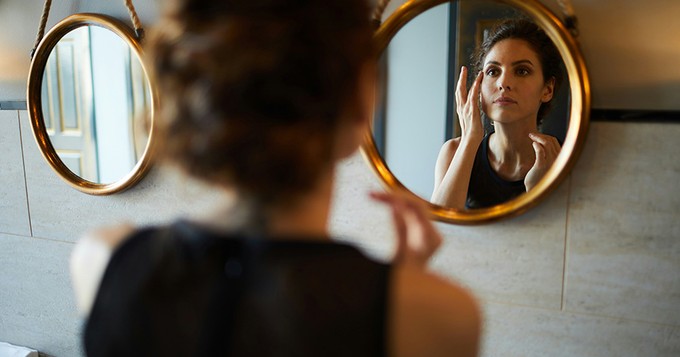

On a recent afternoon, when my doctor sent me for a biopsy, the receptionist rolled the window back, took my name, and asked, “You’re here for Botox, right?”
I blinked.
“No,” I started to respond, and then her words registered. I asked her if that’s what my chart said, and when she confirmed, I started laughing.
“No,” I told her again. “Biopsy.”
As she fixed the coding error, I sat down in the waiting room and watched the medical ads flipping across a screen in the corner with slide after slide about injections to tighten. Smooth. Reverse. Renew. The receptionist’s question had caught me off guard, but as I looked around the room, I wondered if it was more surprising that I wasn’t there for a cosmetic procedure.
We live in an era obsessed with anti-aging, where filters and fillers and wellness trends tell us that looking young is synonymous with being valuable. I’m thirty-four (and a half), and I’ve noticed the shift happening among women in my community over the last several years. As we’ve met up for meals or debriefed our dating lives through voice texts, I’ve listened to single friends process whether or not age has made them less desirable and why it seems “new” is often chosen over faithfulness.
After many of these conversations, I’ve left dinner or set my phone down and thought about how women in later decades would surely find these conversations to be absurd at our age. But the pressures of time and relevance appear in various forms in all decades, and they seem to be encroaching on younger and younger women.
That’s why, when an interview clip of Bible teacher and author Jen Wilkin started making the social media rounds, it caught my attention. In the video, Jen says,
We have a younger generation of women who are being told that in their twenties they should start preventive treatments. What a time to be alive when the only decade in which you can just enjoy looking dewy and youthful becomes one where you’re consumed with fear about the next stages of your life.
I began to have a growing concern about how we are inhabiting a false story of anti-aging when the Bible provides us with the true story of aging. The false story of anti-aging is:
- You should be afraid of getting older.
- Charm is not deceitful.
- A woman who fears the world is to be praised.
- To age is to become obsolete and irrelevant.
And then the true story of aging:
- To age is a privilege.
- Death is not something we have to be afraid of.
- And the old among us are, to borrow from Scripture, ever full of sap and green.
That means that for younger people, there is a form of wisdom that we can only receive from someone who has lived longer than us.
So it’s not a journey into obsolescence. It’s an ever-deepening, burgeoning luminosity in an interior life. If you live a long life, you will watch your body betray you day after day after day after day after day, until all that you are able to do at the end of a long life is the one thing you needed to do all along—and that’s offer glory to God.1
Stories Worth Remembering
The last sentence Jen said has stuck with me. As I finish writing these words, my ninety-year-old grandmother is in the hospital, where she was taken by ambulance. Every few minutes, my phone vibrates with updates from family members.
For years, Grandma has watched her body betray her. She’s told us a hundred times, “Getting old isn’t for sissies.” As I’ve watched her weaken and face physical limitations, it’s put Paul’s words in 2 Corinthians 4 into a different perspective:
Even though our outer person is being destroyed, our inner person is being renewed day by day. For our momentary light affliction is producing for us an absolutely incomparable eternal weight of glory. So we do not focus on what is seen, but on what is unseen. For what is seen is temporary, but what is unseen is eternal. (vv. 16–18)
For Paul, it’s “true, his earthly mortality was increasingly evident,” one scholar writes. “Outwardly he was wasting away. But his heavenly destiny was also increasingly evident. While physically he grew weaker, spiritually he experienced the renewing work of the Holy Spirit day by day. He was becoming increasingly like Christ, a prelude to what will be.”2
I may only be in my thirties, but I’ve certainly experienced brokenness in this body of mine, the same one that sent me to the doctor’s office for Botox—I mean, a biopsy. It’s not that it’s wrong to improve our appearance or want to look more youthful. We’re called to care for our bodies and seek to steward our health amidst challenges that come with age. But while beauty, strength, and vitality are gifts, they’re fleeting.
That’s one of the true stories of aging worth remembering. In each decade, certain falsehoods will feel louder, but in this one, I want to remember: that God alone is sovereign over seasons and time (James 4:14); that aging isn’t a problem but a privilege allowing us to grow in wisdom, godliness, and intimacy with Him (Psalm 92:14–15); that eternal values matter more than temporary approval (Col. 3:2); and that true, lasting beauty is found not in chasing what fades but in reflecting Christ (2 Cor. 3:18).
Layering Beauty That Lasts
These days, women are taught to layer on anti-aging creams, supplements, and treatments with each passing decade, beginning in their late teens and early twenties. It makes me wonder what it would look like to “layer” practices that cultivate unseen beauty: to spend time in God’s Word, allowing it to shape our thoughts, our words, and our actions; to pray not just for our own needs, but for others, training our hearts to reflect what God desires; to grow in gratitude, hospitality, wisdom, and compassion, so that we mirror our Savior more and more.
With each passing decade, we have the opportunity to know Him better, to trust Him more deeply, and to delight in the future with Him that He’s promised.Our energy will fade and our bodies will bend more and more under the aches and pains of earth—but may our capacity for joy in Jesus expand.
Aging then becomes a privilege, not a problem, a chance to grow green and full of sap (Psalm 92:13-15), spiritually vibrant, and luminous from the inside out. The work God is doing in these unseen places contains an eternal beauty that will never fade. Like the light of dawn, it will shine brighter and brighter until full day (Prov. 4:18), until, at last, we spend eternity doing the one thing we were made to do all along—offer glory to God.
1 Jen Wilkin (@lifewaywomen), @jenwilkin joins us for this week’s conversation on Marked to talk about women in ministry and leadership, November 24, 2025, https://www.instagram.com/reel/DQpLEIvjrt0/?utm_source=ig_web_copy_link&igsh=MzRlODBiNWFlZA=.
2 David K. Lowery, “2 Corinthians,” The Bible Knowledge Commentary: An Exposition of the Scriptures, ed. J. F. Walvoord and R. B. Zuck, vol. 2 (Wheaton, IL: Victor Books, 1985), 564.
On Saturday morning, January 10, 2026, Robert Wolgemuth—beloved husband to Nancy DeMoss Wolgemuth—entered the joy of eternity with Christ. While we grieve, we do so with hope, confident that Heaven rules and Jesus is near.
We invite you to remember Robert, reflect on his life and legacy, and share a note of encouragement in his memory.
Visit ReviveOurHearts.com/Robert.
Join the Discussion