
Last year a local news station in Tennessee published an article with a headline that caught my attention. The article told the story of a family rushing out of their burning home, when suddenly the husband had asked the firefighters to go back in and get one thing for his wife: her Bible.
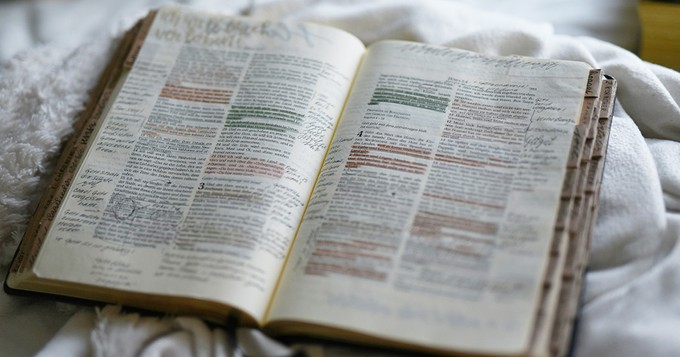
The article didn’t include images, but can you picture her Bible? I imagine it with a worn cover, highlighted passages, penciled notes, and personal prayer requests filling the margins—a story of God’s work in her life that a scrapbook could never fully capture.
Maybe the woman had already walked through painful seasons that taught her the only way to endure is with the truth of God’s Word. Maybe her husband had watched her cling to her Bible before and knew she’d need it again: a testimony of His faithfulness she could hold in her hands, even as flames consume everything else.
It’s not unusual to come across news stories reporting how fires have destroyed various things—cars, buildings, houses—and to find that amidst the rubble a Bible was left unscathed. Is this always the case? Should we test it out at home? Of course not.
But it’s a pretty good metaphor for the durability and permanence of the Word of God. What comfort or strength would Scripture be if it fell apart or faded in times of pressure or when pain presses in?
Yet doubt can make you think the truth of God’s Word isn’t as lasting as you believe. When grief lingers longer than you’d expect or when suffering lasts an unbearably long time, you may begin to wonder if God’s Word will hold firm under the weight of your circumstances or if it will give way under the heat of your trials, leaving you to face the ashes alone.
More Than Quick Comfort
When suffering is brief, a Bible verse in a get-well card or a condolence note is comforting—a gentle reminder that God’s Word offers hope in difficult times. As the days stretch into weeks, months, or even years, the cards stop arriving, friends’ calls become less frequent, and the once-comforting words you leaned on may no longer feel sufficient.
But it’s in those long seasons, when endurance wears thin, that the sufficiency of God’s Word is tested and where its enduring power is proven.
Have you begun to wonder if God’s Word will hold up under the weight of your circumstances? Maybe it feels like the promises you once trusted no longer speak to the reality you face today. You might feel like:
- God’s Word isn’t as lasting as you once thought. Friends’ words have faded over time; maybe His faithfulness will too.
- God’s Word isn’t speaking to your specific situation today. You wonder if you need something more than a verse you’ve heard a hundred times.
- God’s Word feels distant and impractical. You need relief now, and promises about the future don’t seem to address the pain you feel right now.
God’s Word is one of the central themes of Psalm 119, and while it celebrates Scripture, the psalm wasn’t written by someone immune to suffering. While we don’t know for sure who wrote this psalm, it’s clear the author faced his own share of overwhelmingly difficult circumstances. In verse 153, we see him asking the Lord to consider his affliction and rescue him. In verse 92, we get a window into just how severe his situation was:
If your instruction had not been my delight,
I would have died in my affliction. (Psalm 119:92)
But in the midst of affliction, the psalmist came to know that God’s Word is true (vv. 142, 160), reviving (v. 25), good (v. 68), delightful (v. 77), limitless (v. 96), a lamp to his feet and a light to his path (v. 105). This list could continue, but there’s one specific characteristic the psalmist mentions several times in Psalm 119 that’s especially meaningful in the midst of lengthy suffering. In verse 152, he writes:
Long ago I learned from your decrees
that you have established them forever.
The Word Endures
The psalmist knew that the permanence of God’s Word is essential in times of crisis. In Psalm 119:145–152, he faced a lament situation which caused him to cry out:
I call with all my heart; answer me, LORD.
I will obey your statutes.
I call to you; save me,
and I will keep your decrees.
I rise before dawn and cry out for help;
I put my hope in your word.
I am awake through each watch of the night
to meditate on your promise.
In keeping with your faithful love, hear my voice.
LORD, give me life in keeping with your justice.
Those who pursue evil plans come near;
they are far from your instruction.
You are near, LORD,
and all your commands are true.
Long ago I learned from your decrees
that you have established them forever.
Imagine how this psalm would read if the final verse in this section wasn’t true. If the psalmist didn’t believe God’s Word was established forever, consider how he might have responded to his circumstances instead:
- He wouldn’t have called on the Lord with all his heart or sought help to obey His commandments (vv. 145–147). Where would he have turned instead? Who would have been his help?
- He wouldn’t have spent his time meditating on the Word through the watches of the night (v. 148). If the Word was unreliable, these efforts would have been a waste of time, and he wouldn’t have been hopeful or expectant that God’s Word would be fulfilled as he waited.
- His hope would have shifted to temporary sources (vv. 147–148). Without anchoring his hope in God’s Word, he would have clung to fleeting human support or even his own strength, despite knowing how quickly it’d fail him.
- Fear would dominate (vv. 150–152). The psalmist would be far more vulnerable without God’s promised nearness, and he’d be left to survive alone in the midst of prolonged trials.
If the Word wasn’t sufficient or permanent, if it expired after a certain amount of time, Psalm 119 would read as a cry of despair rather than a declaration of hope. But the psalmist was confident. As one Bible teacher has said,
The psalmist had an old relationship with the word of God. The great love and appreciation he had with the Scriptures was not a youthful surge of infatuation; it was the deep, settled love with roots made deep by time.
His long love and appreciation for the Scriptures led him to understand that they were eternal (founded...forever). The more he studied and meditated upon them, the more he understood their divine origin. . . . This was his testimony to answered prayer.1
Knowing that God has established His decrees forever and would fulfill His promises eternally gave the psalmist assurance. The same assurance is available to you today—it’s not purely theoretical. As you turn to Scripture, obey it, and rely on it in the midst of real-life suffering, you prove it’s still sufficient. You prove that every promise the Lord has made will hold true.
A Permanent Hope
God’s Word is more than enough when your suffering stretches long. If you’re in a season of prolonged grief or painful circumstances, now is not the time to hope human solutions outside of Scripture will somehow sustain you. The truth of the Bible will outlast every trial and outlive every circumstance.
The Word holds strong—through fires, through fear, and through seasons you were never meant to face alone. May this one teach you what the psalmist himself learned long ago:
You are near, LORD,
and all your commands are true. . . .
you have established them forever. (Psalm 119:151–152)
Register now—and come expectant.
1 “Study Guide for Psalm 119 by David Guzik,” Blue Letter Bible, accessed August 19, 2025, https://www.blueletterbible.org/comm/guzik_david/study-guide/psalm/psalm-119.cfm?a=597145.
Join the Discussion