
Dannah Gresh: Nancy DeMoss Wolgemuth has some good news for you. Actually, it’s the best news ever.
Nancy DeMoss Wolgemuth: We have a great redeeming God who sent His Son to be our Redeemer. It’s no wonder the psalmist said, “Let the redeemed of the Lord say so, whom He has redeemed from trouble” (Psalm 107:2).
Dannah: This is the Revive Our Hearts podcast with Nancy DeMoss Wolgemuth, author of Brokenness: The Heart God Revives, for October 9, 2026. I’m Dannah Gresh.
This month, we’re looking to Jesus together each day. We’re talking about His character, His names, and who we become when we belong to Him. What a joy, right?! Really, this is what we do all year round on Revive Our Hearts, but I love this special focus on Jesus in October.
Yesterday, we heard from Heidi Jenkins—how she experienced deep, life-transforming …
Dannah Gresh: Nancy DeMoss Wolgemuth has some good news for you. Actually, it’s the best news ever.
Nancy DeMoss Wolgemuth: We have a great redeeming God who sent His Son to be our Redeemer. It’s no wonder the psalmist said, “Let the redeemed of the Lord say so, whom He has redeemed from trouble” (Psalm 107:2).
Dannah: This is the Revive Our Hearts podcast with Nancy DeMoss Wolgemuth, author of Brokenness: The Heart God Revives, for October 9, 2026. I’m Dannah Gresh.
This month, we’re looking to Jesus together each day. We’re talking about His character, His names, and who we become when we belong to Him. What a joy, right?! Really, this is what we do all year round on Revive Our Hearts, but I love this special focus on Jesus in October.
Yesterday, we heard from Heidi Jenkins—how she experienced deep, life-transforming forgiveness after abortion. Now, God not only pardoned her sin through Christ; He redeemed her entire story. It’s a story she’s telling to help other women and offer real hope. She’ll tell us about that in just a little bit.
If you’re redeemed, you, too, have a story to tell! That’s what this episode is all about. Let’s begin by remembering what redemption really means. Here’s Nancy DeMoss Wolgemuth to refresh our understanding with God’s Word.
What Redemption Really Means
Nancy: The word “redemption” speaks of deliverance. It speaks of rescue and release and recovery. The word “redemption” is a word of "hope in the midst of seemingly hopeless circumstances." Anybody here facing maybe something like that? You need some redemption?
When your situation seems dark, and there appears to be no light at the end of the tunnel, the promise of redemption is that there is a different, brighter future ahead. And when you’ve blown it and you think you could never dig yourself out of the hole that you’ve dug and that there’s no way that God could ever use you again, redemption promises that your failure and the losses that have been caused by your sin can be overruled and that you can be redeemed and restored to usefulness.
Three Components of Redemption
Now, as we look at the Scripture, there are three important components of redemption, and we want to unpack those a little bit.
First of all, in order to have redemption, there has to first be a need, a desperate predicament. We have to be redeemed from or out of something. Psalm 25:22 says, “Redeem Israel, O God, out of all his troubles”—redeemed out of troubles, a desperate situation. That situation all throughout Scripture is sometimes bondage or slavery or captivity. God redeemed His people out of captivity.
It could be being redeemed out of misfortune or trouble. That trouble might be the loss of property or poverty or imprisonment for debt. God made provision for these people to be redeemed, and that redemption brings about deliverance and release and restoration.
A person who has no need, has no need for redemption; and a person who has no need, has no need for a Redeemer. You have to have a need. You have to be desperate. You have to be in a predicament from which you cannot extricate yourself in order to experience redemption.
So first there’s a need. And then secondly, there’s a Redeemer. The assumption there is that we cannot redeem ourselves. We are helpless; we’re caught; we’re stuck; we’re trapped. We can’t get out ourselves. We can’t claw our way out. We can’t work our way out. We can’t reason our way out. We’re stuck. We have to have somebody reach out and help us. We need a Redeemer. We can only be redeemed by the action of a Redeemer. In just a few moments, we’re going to look at some of the qualifications of a Redeemer.
So, first there’s a need. Second, there’s a Redeemer. And then third, there’s a price to be paid. To redeem someone or something means to buy it back by paying a price. For example, to free someone from bondage or poverty or imprisonment, you pay a price. It may be called a ransom. It’s a word that’s related to redemption. You pay a ransom price to get this person out of bondage.
Now, the concept of redemption is first introduced in the Old Testament in what we know as the exodus—the exodus, the release of the children of Israel out of Egyptian captivity. This is called the exodus, and the exodus is the “backstory,” if you will, that sets the stage for the New Testament concept of redemption.
The exodus in the Old Testament points to the larger story of God’s redeeming power and grace. It foreshadows the gospel. The exodus in the Old Testament is a type of the ultimate redemption yet to come that is fulfilled in Christ the Redeemer. So the exodus is an important story. Let me read just a piece of that story. In Exodus 6:6, God says to Moses:
Say therefore to the people of Israel, "I am the Lord, and I will bring you out from under the burdens of the Egyptians, [You see the need there? Bringing them out] and I will deliver you from slavery to them, and I will redeem you with an outstretched arm and with great acts of judgment."
So you see in that verse all three components of redemption. You see the need, the desperate predicament. The children of Israel were slaves. They were in bondage to Pharaoh, and they had been for four hundred years . . . generation after generation after generation. “My father was a slave. My children will be slaves. Their children will be slaves.” There was no hope of this ever changing.
And so the children of Israel were delivered “out of Egypt.” That’s a frequent phrase in the Old Testament—“out of Egypt.” The Scripture keeps going back to it because it foreshadows the New Testament concept of salvation and our deliverance out of slavery to sin, God’s redeeming work.
So the children of Israel had a need: they were slaves. And by the way, redemption means to be rescued or delivered “out of” something—a desperate situation or circumstance—and “into” a new place—a place of freedom, a place of blessing. And the whole point is that you don’t go back to slavery. Why would you ever want to?
So we see in the story of the exodus, that there’s a need, and then we see in Exodus 6 that we just read, there’s a Redeemer. "I am the Lord . . . I will bring you out . . . I will deliver you . . . I will redeem you.”
Jesus, Our Redeemer
There is a Redeemer, one who paid the price to win back all the losses occasioned by your sin. And that’s the basic storyline of the whole Bible.
- God created us; we belong to Him.
- But as a result of sin and rebellion against God, the entire human race was sold into captivity to Satan.
- As a result, we are all under the curse of the law, and we face the threat of divine judgment and death.
- But because of His immense love and mercy, God provided a means by which we could be redeemed, and He did so at great personal cost.
- He sent His Son to give His life, to shed His blood, to die as our substitute, to be our Goel.
And so when John the Baptist, the forerunner of Jesus Messiah, was born, his father said at the birth of that son, “Blessed be the Lord God of Israel, for He has visited and redeemed his people” (Luke 1:68).
And when Anna, that elderly widow, saw the baby Jesus being brought into the temple to be dedicated by Joseph and Mary, it says:
And coming up at that very hour she began to give thanks to God and to speak of him [of that child] to all who were waiting for the redemption of Jerusalem. (Luke 2:38)
God’s promised redemption, the one that prophets had foretold for hundreds of years. That promised redemption was fulfilled in Jesus Christ
Who gave himself for us to redeem us from all lawlessness [redeeming us out of our desperate plight, out of our captivity] and to purify for himself a people for his own possession who are zealous for good works. (Titus 2:14)
Galatians 3:13:
Christ redeemed us from the curse of the law by becoming a curse for us—for it is written, "Cursed is everyone who is hanged on a tree."
And then 1 Corinthians 1:30:
And because of him you are in Christ Jesus, who became to us wisdom from God, righteousness and sanctification and redemption.
[The Redeemer] In him we have redemption through His blood [that’s the ransom price], the forgiveness of our trespasses, according to the riches of his grace. (Eph. 1:7)
The redemption that we get through Jesus Christ provides deliverance from the penalty and the power of sin, and one day from very presence of sin, and from every last vestige and effect and consequence of sin in this world.
Redemption, ultimately, from death and from the power of Satan and redemption from the wrath of a holy God and the coming judgment. Through Christ our Redeemer, 1 Peter 1 tells us, we have been redeemed from "empty religion" (v. 18).
Then Romans 8 gives us that incredible promise that one day the whole creation will be redeemed. We will experience the "final [ultimate] redemption of our bodies" (v. 23)—new bodies, a new heaven, and a new earth. We have a great redeeming God who sent His Son to be our Redeemer.
It’s no wonder the psalmist said, “Let the redeemed of the Lord say so, whom He has redeemed from trouble” (Psalm 107:2).
Dannah: What an encouragement. We have a Redeemer, and His name is Jesus.
Now, I want to really lean in on that last passage Nancy quoted. It’s Psalm 107:2. “Let the redeemed of the Lord say so, whom He has redeemed from trouble.”
It’s kind of old English-y, but when the psalmist says, “Let the redeemed of the Lord say so,” he’s really saying, “Let the redeemed of the Lord tell their story.” He’s inviting us to testify to God’s particular redeeming work in our lives.
That’s what Heidi Jenkins has been doing since God redeemed her, setting her free from the shame of abortion. She and I had a conversation about that.
Hope and Healing After Abortion
Heidi, it’s important for women to know they’re not alone, right? They’re not the only ones who are suffering the way that they are.
Heidi: Yes. I think women feel so isolated after experiencing an abortion. Therefore, if they can see other women expressing their feelings and feel that they’re not alone, there is healing.
Dannah: They certainly are not alone. There seems to be a rise in women who are choosing abortion. Some people are saying that that might correlate to the increase and availability of abortion pills, which make it “easier” for a woman to pursue an abortion.
You’ve been vocal about your concern that that can be equally as traumatic, if not more so, than surgery. Tell me why you think that?
Heidi: The pills are easily accessible. Women are told, most of the time, “Go home and do it in the privacy of your own home.” And what that means to many women is that they go home, alone, and take the pills. Some of them experience extreme pain and cramping and extreme bleeding.
Many women have shared with me that they have seen their baby pass from them, and that is very traumatic. Many women bleed so much that they get into a bathtub because the blood is that excessive.
Dannah: That would be a very traumatic and lonely experience.
Heidi: Yes. Many women end up in the Emergency Room. There are some women who say, “Oh, it wasn’t so bad.” But for the most part, many of the women that I’ve spoken to have described just a horrible experience of taking the abortion pills and being in violent pain, screaming. And if no one is there to help them, they just feel completely alone. And they’re reluctant to go to the Emergency Room because this is something they elected to do.
Dannah: I would imagine, too, that they would be surprised by that, based on the information, the propaganda, the ads, what they’re being told. They’re probably surprised when they find themselves in that place of it being such a frightening experience.
Heidi: It’s very traumatic for so many women, and I think it complicates the healing process because it’s so graphic. And I think that it produces more guilt and grief than the surgery because it’s so graphic.
Dannah: Again, there is healing. There is hope. They’re not alone. You’re not alone, if that’s your story. Heidi is not sharing this today to increase your guilt, to increase your shame . . .
Heidi: No.
Dannah: . . . but to offer you a lifeline of hope.
Heidi: Satan doesn’t want healing through Jesus. He would rather we stayed in the guilt and shame box and continue to suffer and continue to hide. Shame is a very big factor.
Dannah: There’s a lot of conversation today about shame. In the last decade or so, I’ve been so encouraged that the conversation around shame was moving to the forefront, because I think that there is toxic, unhealthy shame that Satan creates.
I once heard something to the effect of, “There’s no one that’s more pro-abortion than the devil when a woman is walking into an abortion clinic. And there is no one that’s more pro-life than the devil when that same woman is walking out of an abortion clinic.”
I thought, That’s so true! He changes the lies up on us. And one of the things is he takes something called shame, and he twists and distorts it to the place where we believe, in your words, “This is an unpardonable sin,” which is not true.
So I want to ask a question about shame because I think that shame in God’s hands can be a tool that leads us to His loving forgiveness and redemption.
Heidi: It certainly led me in that direction.
Dannah: Tell me how.
Heidi: I couldn’t live with my shame. As I said, I was extremely depressed. I didn’t know how to put one foot in front of the other. And yet, I had two small children who I needed to take care of. My husband, at the time, had been promoted, and he was traveling a lot. So I needed to function. I knew that if I didn’t find healing that I wouldn’t be able to function as I couldn’t live with myself.
So at the time, my husband and I had started attending Redeemer Presbyterian Church in New York City, which was started by Tim and Kathy Keller. Listening to Tim preach, not directly about abortion, but somehow his wisdom seemed to blanket so many different areas of my life.
Pastor Tim Keller: The gospel is not just the minimum Christian doctrine required to believe in order to go to heaven when you die. At Redeemer we have always taught, because the Bible teaches, that the gospel changes your life now, and it changes every part of your life. It changes you from the top to the bottom, from the inside out.
Dannah: This is Tim Keller, who passed away in May of 2023. He was Heidi Jenkins’ pastor. The Lord used his gentle, Gospel-centered teaching to work in her heart. For example, in this message Tim Keller was referring to the encounter that Jesus had with the woman at the well.
Pastor Keller: He thirsted. He got the cosmic thirst so we could get the water of life. And, you see, it’s not just to know the water of life gives you the joy. You have to see what it cost Him to give it to us, and that will change your heart. That will change your heart.
When she gets that, she will not need men the way she did. You won’t need men or women the way you do. You won’t need money. Money just becomes money. Men just become men. Women just become women. Romance becomes a good thing, but not the most important thing. You’re free!
Do you know what the power of a changed life is? Do you know how radical it is? How radically your life can change if you don’t see religion and morality as the way you change your life and effort, but you see the grace of God that comes in, electrifies you, and changes the very basis of your self-image, of your identity, the very foundations of your heart.
Stop Listening to Yourself and Start Talking to Yourself
Heidi: He often talked about a Welsh doctor and minister named Martyn Lloyd-Jones.
Dannah: Oh, I love Martyn Lloyd-Jones!
Heidi: Martyn Lloyd-Jones said, “Stop listening to yourself and start talking to yourself.” And that really stuck with me because I had been listening to myself as opposed to pouring the truth of God’s Word into myself.
Dannah: Yes. And so instead of just listening to the guilt and the shame and the messages of condemnation, you start to find some of those Scripture verses that you mentioned about forgiveness and the truth that my sin is as far as the east is from the west. That’s how far away it is from me. You start to tell yourself those things. That’s what he was meaning by that.
Heidi: Yes. Exactly. At the time I was attending Kathy Keller’s Bible study when she encouraged me to write out my testimony and asked me to share it on Easter Sunday at Redeemer. Kathy was instrumental in editing my drafts. After I told my story, many women came up to me and thanked me for sharing my story.
There’s some wonderful books out there that also talk about healing from abortion. One of them that I recommend over and over again is called, Her Choice to Heal by Sydna Massé.
Dannah: I love Sydna! She’s precious.
Heidi: And there’s one called, Will I Cry Tomorrow? by Susan Stanford-Rue. That’s probably out of print by now, but that was also one that I just resonated with because it was one of the first ones I read that showed me that, yes, other women do have some of these same feelings after experiencing abortion.
So, talking to myself and filling my mind with information that helped me to heal was key in moving forward.
Dannah: You know, Heidi, you mentioned that what was winsome and compelling to you about Chuck Colson is that he seemed to have a peace about him. I feel like, as I sit here looking at you on Zoom, you have that peace about you, and you have wisdom about you.
It’s evident to me that that night that you received Christ because of Chuck Colson’s testimony that he passed a baton of faith on to your heart that you’re passing on as hope to other hearts today. I wonder, would you pray for the woman who’s maybe in the middle of your story, and she’s not at that place of peace just yet? Would you pray for her?
Heidi: Oh, yes.
Father, I thank You for this opportunity to share my story that may help other women who’ve experienced something similar. I pray that any woman listening today would know that You hear her feelings of shame and embarrassment, that You gather her tears in a bottle, that they are not hidden from Your being.
Thank You, Lord, for providing permission to heal, permission to express anger, permission to talk about what we formerly, and some women may still feel is unforgivable. But, Lord, You do tell us that “when we confess our sins, You are faithful and just to forgive us and to cleanse us from all unrighteousness,” and all unrighteousness means everything. There isn’t any one sin that Your forgiveness doesn’t cover.
So, Lord, please enable any woman listening who has experienced an abortion or a pregnancy loss of whatever sort, to find comfort in knowing that You accept her, that you love her, and that You are holding her in Your arms.
Father, also help women to know that any child that was aborted is with You and is thriving with You. And so, please give women that reassurance that they are peaceful and happy and well-taken care of until we meet again, as King David said when he lost his son.
We just pray this in the powerful name of Jesus, our Lord and Savior, amen.
Dannah: Amen. I love the way God is using Heidi’s story to encourage her church family, our Revive Our Hearts family, and surely so many others. There is hope after abortion because Jesus really does redeem.
Would you let God use your story, too? Take some time to think through the narrative of God’s redemptive work in your life. Maybe even grab a pen and paper or open up a Word doc so you can really capture it. Then ask the Lord, “Who needs to hear my story of redemption? Open the doors for me to tell it.” I have a hunch that’s a prayer He’ll be glad to answer.
If you’d like to hear some more examples from women who have testified to God’s redemptive work in their lives, we’ve got so many beautiful stories on our website. We’ll link to some of those in today’s transcript at ReviveOurHearts.com. That’s where you’ll find the full-length version of Heidi’s story, too.
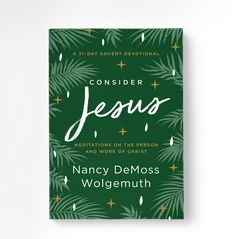
And, if you’d like to dive even deeper into the heart of Christ this Christmas, Nancy DeMoss Wolgemuth has just released the most beautiful resource to help you do that. It’s called Consider Jesus: Meditations on the Person and Work of Christ. In the midst of all that feels frantic during the holidays, this 31-day Advent devotional draws your Spirit back to what really matters.
It’s Jesus, the One who came to be near to you, to rescue you, and to give you a redemptive story to tell. We’ll send you a copy when you make a donation of any amount this month, so head on over to ReviveOurHearts.com, or call us at 1-800-569-5959 to request yours.
Nearly a quarter of evangelicals today reject Jesus as God. This is a devastating statistic, isn’t it?! Nancy DeMoss Wolgemuth explains why the Lordship of Christ matters so deeply for each of us and invites you to reclaim a reverent heart toward Jesus on Monday.
Please be back for Revive Our Hearts.
This program is a listener-supported production of Revive Our Hearts in Niles, Michigan, calling women to freedom, fullness, and fruitfulness in Christ.
*Offers available only during the broadcast of the podcast season.